
How to deep-clean a bathroom, topic: wet-room vinyl flooring, vinyl walls
Sara IdenforsIn this blog, we take you through a guide to thoroughly cleaning an ordinary bathroom in a Swedish detached house with plastic mats on both the floor and walls. Using simple products such as soap, a brush, and hot water, we remove deeply embedded dirt from the mat. We also share tips for cleaning other bathroom fixtures and fittings, such as the toilet, shower curtains, and floor drains.
Last edited on May 8, 2024

In this blog, we will guide you through a thorough bathroom cleaning, including a bathroom with plastic wet-room mats on both the floor and walls.

This is what the bathroom looks like before we begin. An entirely ordinary bathroom in a family with children.
Above, you can see the starting point. An entirely ordinary bathroom in a typical Swedish detached house built in the 1980s, with plastic mats on both the floor and walls. The bathroom is used by a family with several children who, like everyone else, have too little time for cleaning. We are going to help them with a thorough clean, and you can follow along step by step.

Plastic bathroom mat, wet-room mat: this is how you clean it thoroughly
This is what the bathroom mat looks like up close. As you can see, the mat has a textured surface. This is good because it makes the mat less slippery when wet, but dirt also settles into the texture. Manufacturers and tradespeople recommend drying/wiping plastic mats at least once a week to keep them clean, but honestly… not everyone does that. There may not always be time to mop once a week, and then dirt gets stuck in the texture. At that point, it is no longer possible to mop the dirt away. Instead, we will remove it with a regular scrubbing brush and soap.
Soap with an excess of fat and a high pH value will easily dissolve the dirt embedded in the mat's structure. The alkaline part of the soap removes all the dirt that comes from plants or animals—which is most of it, including what comes from us or what we bring in with us.
The fat in the soap will dissolve all the fatty parts of the dirt—following the principle: like dissolves like!

This is what you need to scrub the dirt off a bathroom mat or wet-room mat
Here we use our own Bathroom Soap, a soft scrub brush, and an eco-fiber cloth. A small amount of warm water and soap—and then it is simply a matter of scrubbing on your knees. Scrub carefully in corners and joints, and everywhere the dirt is embedded in the mat. Please note that joints between mats, wet-room mats, and floor mats often contain traces of glue or silicone. If you try to scrape away the silicone or glue, you risk causing water damage. Unfortunately, dirt and mold can find their way behind and underneath silicone and glue and discolor them. To remedy this, you need to contact a professional. Scraping it away with, for example, a razor scraper can damage the moisture barrier. So if you discover that a glued edge has become discolored in such a way that it cannot be scrubbed clean, you need to contact a knowledgeable flooring installer to fix the problem.

Wet-room mat after being scrubbed with soap
This is what the plastic mat, or wet-room mat, looks like after being scrubbed with soap. As you can see in the picture, the dirt embedded in the texture has come loose, and the mat is clean and looks great. Keep in mind that when scrubbing plastic with soap, you must rinse and dry it thoroughly. Soap should not be left on non-absorbent materials such as plastic. Plastic will not absorb the fat in the soap the way a wooden floor does; instead, the excess will form a film and become very slippery when the floor gets wet again. So after scrubbing the dirt out of the mat, wipe up all the water and dirt with a cloth. If it is possible to rinse the floor, you can do so and then carefully remove the water with a floor squeegee. However, make sure the room allows this so that you do not cause water damage.

Before and after scrubbing a plastic wet-room mat with soap
On the left, you can see the dirt in the mat and its texture, and on the right, the same mat after being scrubbed with soap and a brush.
Quick overview
- Scrub with a brush, hot water, and soap.
- Wipe with a scrubbing cloth, or rinse and squeegee it with a floor squeegee.
- Make sure no soap is left on the floor covering, as it can make it very slippery when it gets wet next time.
- During the next cleaning, the floor can be mopped as usual with a couple of drops of dish soap in the bucket.
The toilet and cleaning it

Scrub the toilet with soap
Wiping the toilet with a cloth and a little soap spray from time to time is a good habit, but it does not replace deep cleaning.
Most toilets are attached to the floor with screws, creating an edge between the porcelain and the floor where dirt easily hides. We solve this by also scrubbing around the toilet itself with soap. The scrubbing brush, water (hot water), and soap remove the dirt you can never get rid of, no matter how much you wipe with a cloth—in the screw grooves and between the floor and porcelain. So, by deep-cleaning this area with a scrubbing brush as well, the toilet becomes thoroughly clean and neat. While you have the scrubbing brush out, take the opportunity to scrub underneath the cistern and the pipes that supply the toilet with water. These pipe connections and joints quickly become dirty, even if they are not very visible. If your toilet has a flush button, there may also be an edge around it that benefits from being scrubbed with soap.
The toilet seat itself and the holes it is attached to are cleaned in the same way. Lift off the toilet seat, place it in the shower or bathtub, and scrub it clean in the joints and around the “pegs.” Scrub the porcelain clean and wipe it with a cloth before putting the seat back. Your toilet is now as good as new.

Bathroom accessories that get grimy so easily
Things we store in the bathroom quickly and easily become dirty, and we perceive them as unhygienic. It takes an awful lot of time to wipe and polish everything clean, especially when there are many people in the household, as the number of bottles and accessories quickly adds up. A very simple trick is to gather everything in the bathtub or shower, use soap, a brush, and an eco-fiber cloth if needed, and scrub everything clean. Rinse the items and let them drain and dry while you clean the rest of the bathroom. The small edges and folds around pump bottles' pumps will then be completely clean—almost like new.
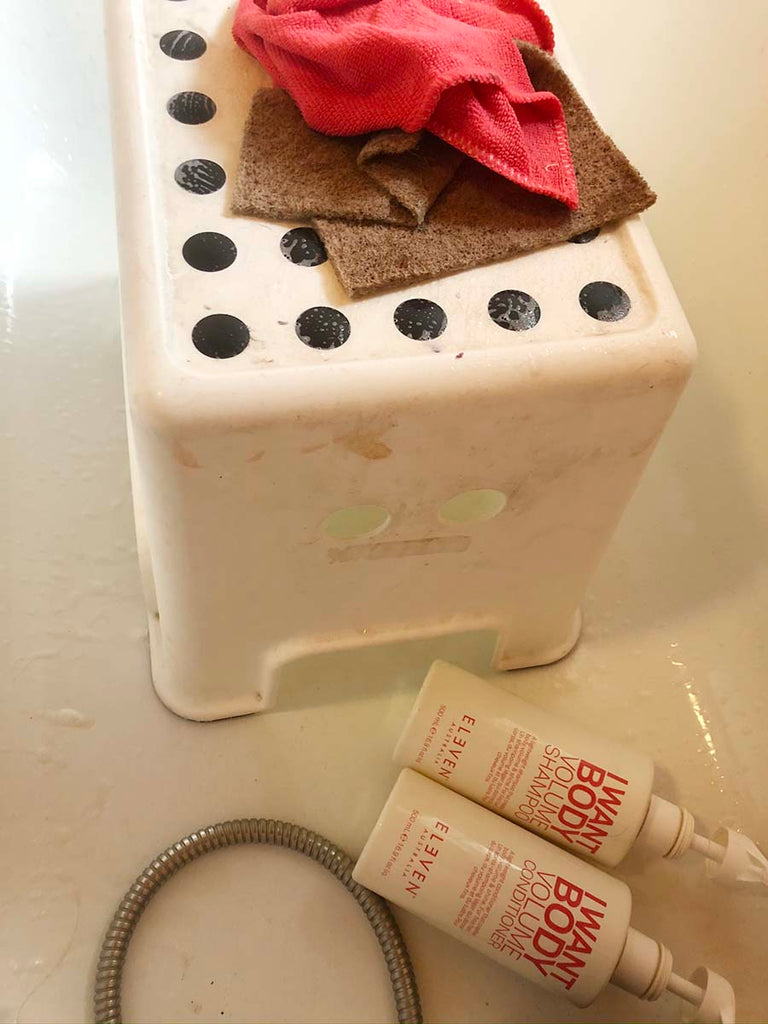
clean things in the bathroom with soap and a brush

clean things in the bathroom with soap and a brush
Shower curtains and how to clean them
Shower curtains are a chapter of their own. They're useful to have, but few things become as dreary as a curtain.

What you need to clean the shower curtain
To remove mold and algae from the family's two curtains, we use bathroom soap, an eco-fiber cloth, and the washing machine. Both curtains are affected by mold, so we pre-treat both sides along the edges where the mold is located, using soap and warm water on an eco-fiber cloth. We then machine-wash them according to the care instructions. Note that a very plastic-like (often inexpensive) curtain cannot always be saved. The washing machine may ruin it, but it may be worth trying to save it. Everything we can reuse, repair, wash, and repurpose instead of buying new is beneficial both economically and environmentally. If permitted by the care instructions, 60°C is preferable.

Shower curtain before and after cleaning with soap
Before on the left and after on the right. Shower curtains become completely clean when the edges are pre-treated with soap and then washed in the machine.
When you deep-clean your bathroom, don't forget to clean the floor drains and other drains.
It isn't fun, BUT it is by far the easiest way to avoid water damage. Cleaning the floor drain so that all the water flows where it should is inexpensive insurance and something that can actually be done quite quickly. There is a separate blog post about floor drains and the not entirely pleasant task of cleaning one here on the cleaning blog.
Don't forget to remove the front panel of the bathtub, if there is one, and wipe the tops of the bathroom cabinets. Is it necessary, asks the more practically minded? —Yes, by keeping the entire bathroom clean, dust and dirt won't swirl around and immediately make your otherwise clean surfaces dusty again.

Don't forget to clean the tops of the bathroom cabinets either
The bathroom is clean!

Freshly scrubbed bathroom—the plastic mat looks like new after being scrubbed with soap
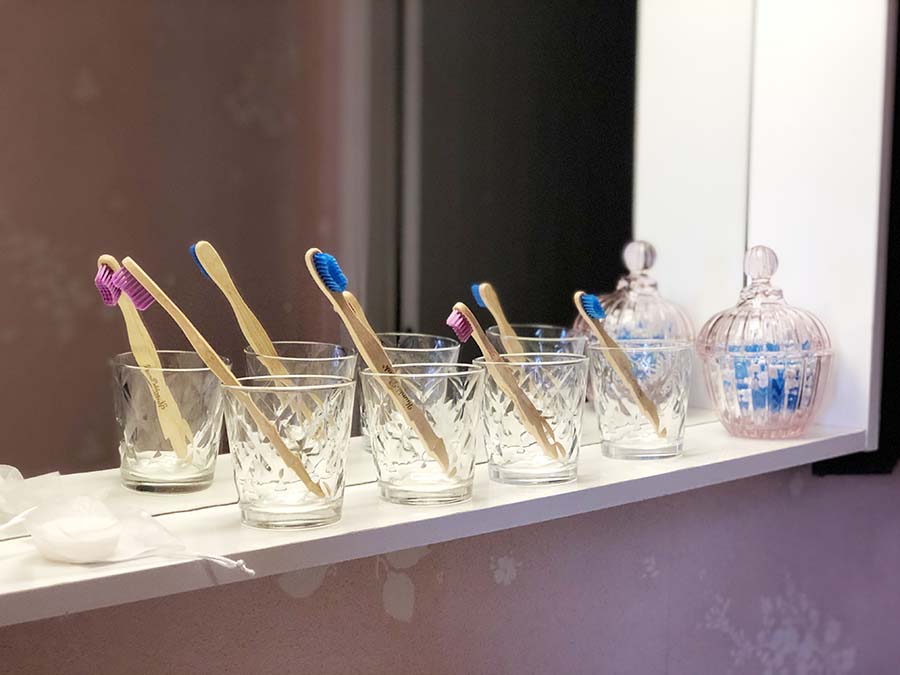
As a little bonus, we took the opportunity to replace the family's toothbrushes with eco-friendly bamboo toothbrushes, and their shampoo and conditioner with solid shampoo and conditioner bars. It's not only climate-smart but also saves an incredible amount of space in the bathroom. Imagine not having all those shampoo bottles and jars; instead, you only have two small, attractive solid “soaps”.
Watch the video clip here
__________________________________________________________________________
Questions and Answers
- How do you deep-clean a plastic bathroom mat?
A plastic bathroom mat can be deep-cleaned using a soft scrubbing brush, warm water, and soap. This helps loosen the dirt trapped in the mat's texture.
- Why is it important to clean the joints and edges between bathroom mats and walls as well?
It is important to clean joints and edges to prevent dirt and mold from accumulating there. If these areas are not cleaned regularly, it can lead to discoloration and the growth of unwanted microorganisms.
- How do you clean a toilet thoroughly during a deep clean?
To clean a toilet thoroughly during a deep clean, use a scrubbing brush together with warm water and soap. This helps remove dirt and bacteria from joints and hard-to-reach areas around the toilet.
- What are some tips for cleaning bathroom accessories that quickly become dirty?
A simple trick is to gather all the bathroom accessories in a bathtub or shower and use soap, a brush, and an eco-fiber cloth to scrub them clean. This helps clean even small edges and folds that otherwise easily become dirty.
- How can you clean and freshen up shower curtains?
To clean and freshen up shower curtains, you can use bathroom soap together with warm water and an eco-fiber cloth to pre-treat the edges where mold may be present. The curtains can then be machine-washed according to the care instructions to remove mold and algae.