All-Purpose Soap Spray x2, Juniper Scent
- Stop paying for water and plastic
- Bottle made from POP plastic – plastic collected before it reaches the ocean
- Tough on dirt, gentle on you and the environment
Unable to load pickup availability
About the Product
Can you clean naturally AND achieve fantastic results? Answer: YES!
This kit includes:
- 1 reusable bottle for soap spray, 0.5 L
- 2 highly concentrated refills with a juniper scent
Usage
Tips on how to use your soap spray
- For all everyday cleaning - spray on and wipe with a cloth.
- Living room tables/cabinets – Spray on and wipe with a damp cloth. Glossy table surfaces / glass tables – wipe dry with paper towels.
- Frames, trim, doors – Spray on and wipe with a slightly damp cloth. Remember to do this more often during cold and stomach bug season. Note – wash / boil your cloth regularly to prevent the spread of infection.
Reuse the plastic bottles several times with our soap refills, which you can purchase separately when it’s time to refill them.
Tip!
For sensitive surfaces such as fine parquet floors, spray onto a damp microfiber mop and clean the floors using only soap spray and the slightly damp mop.
Information
Specification:
- 0.5 L recyclable PET bottle.
- The refill bottles are made of POP, Prevented Ocean Plastic, Recycled plastic collected from beaches around the world. Producing recycled plastic generates 5 times less carbon dioxide emissions than conventional plastic; in addition, the POP program reduces the amount of plastic in our oceans.
- Our soap contains only water, soap (saponified rapeseed oil) 15–30%, and optional fragrance.
Safety tips:
- Do not leave unrinsed soap on the floor, as it may cause slipping.
- Not for consumption! Store separately from food.
- Store at room temperature.
- Keep out of reach of children.
- Do not use on surfaces painted with linseed oil paint.
- Keep out of reach of children and heat sources.
If you are unsure about how to use the product, contact us at info@vasterbottenssapa.se. For the ingredient list, see each product’s main page.
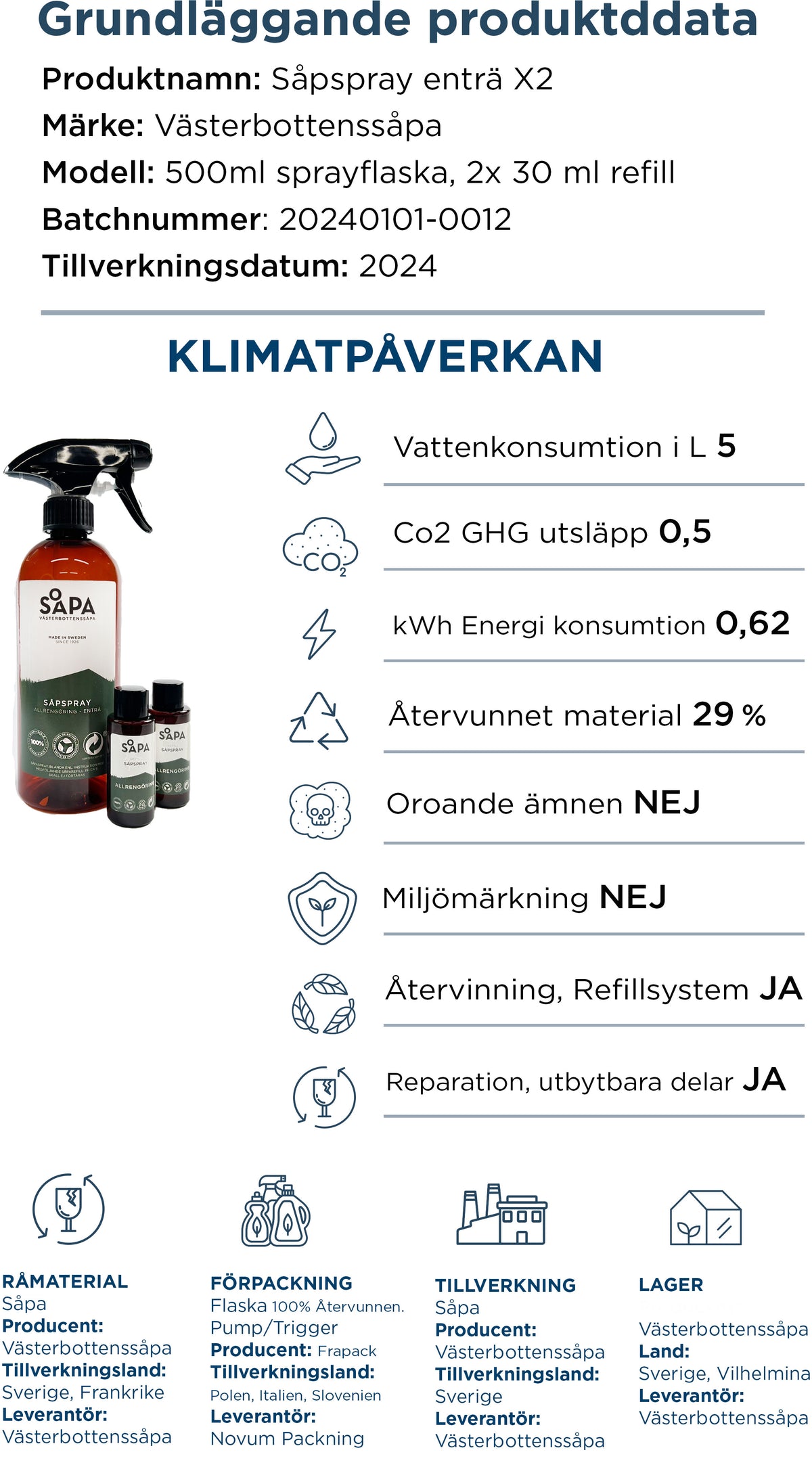
Produktpass
Half a million Swedish households clean with Västerbottenssåpa
-
Natural & Reused Ingredients
-
Free from Toxins, Parabens, and Preservatives
-
All our products are manufactured in Vilhelmina, Västerbotten.
-
Refills made from “Prevented Ocean Plastic”
What sets Västerbottenssåpa apart from “ordinary” soaps bought at the grocery store?
Västerbottenssåpa has similar properties to a linseed oil soap, which is therefore a superfatting soap. Other soaps bought in, for example, grocery stores are not superfatted and are therefore not as effective. Soaps and cleansing bars contain varying amounts of excess oils and fats—that is, the portion of fat that remains after saponification. Västerbottenssåpa has a greater excess and is therefore especially nourishing and replenishing.
Here’s how easy it is to mix your soap spray
Step 1
Pour the entire refill into a 0.5-liter spray bottle.
Step 2
Fill the bottle with water.
Step 3
Shake the bottle lightly. Then it’s ready to use.
Step 4
Empty bottle? Refill it with a new refill. Our refills are made from POP plastic—plastic collected from beaches before it reaches the oceans.
Frying oil becomes soap: “Eco-friendly and climate-smart”
It has always been important to us to make real soap, without adding unnecessary chemicals, and to deliver nothing but PURE soap.
The history of Västerbottenssåpa began in the 1920s, when great-grandmother Fredrika made her own fine soap at home on the farm in Hornsjö, Vilhelmina.
Three generations later, Fredrika’s legacy of living sustainably and frugally, and reusing materials, lives on in the family—albeit in a modern version adapted to the times we live in today.
Our soap, based on Fredrika’s recipe, has been given packaging, a label, and a name—Västerbottenssåpa.
Instead of the sheep fat Fredrika used, Västerbottenssåpa is now made from used cooking oil collected from selected local restaurants. It is mostly rapeseed oil or a corn and rapeseed oil blend—but NEVER palm oil or animal fat.
The oil, which is purified and saponified, then forms the basis of all our soap-based cleaning products.
It has always been important to us to make real soap, without adding unnecessary chemicals, and to deliver nothing but PURE soap.
The history of Västerbottenssåpa began in the 1920s, when great-grandmother Fredrika made her own fine soap at home on the farm in Hornsjö, Vilhelmina.
Three generations later, Fredrika’s legacy of living sustainably and frugally, and reusing materials, lives on in the family—albeit in a modern version adapted to the times we live in today.
Our soap, based on Fredrika’s recipe, has been given packaging, a label, and a name—Västerbottenssåpa.
Instead of the sheep fat Fredrika used, Västerbottenssåpa is now made from used cooking oil collected from selected local restaurants. It is mostly rapeseed oil or a corn and rapeseed oil blend—but NEVER palm oil or animal fat.
The oil, which is purified and saponified, then forms the basis of all our soap-based cleaning products.
Contains only three ingredients
Our soap contains only water, soap (saponified rapeseed oil) 15–30%, and optional fragrance
Let us tell you how it all fits together
Because the soap is made from recycled raw materials—that is, it is circular—the product’s CO2 emissions are very low. One bottle of soap, including production, packaging, and transportation, has CO2 emissions of approximately 237 g. This can be compared with the emissions from producing 1 kg of palm oil, which are approximately 10 kg.
-
Canola oil is produced as a food product
-
Rapeseed oil is used by restaurants throughout the country.
-
Västerbottenssåpa sources the oil that is purified at the small factory in Vilhelmina. It is then saponified into soft soap.
-
The soap will be mailed to you.
Frequently Asked Questions
How do I mix soap spray?
Empty the entire contents of the refill into the spray bottle. Then fill the rest with water (approx. 0.5 liters).
What is the difference between soap spray for the bathroom, kitchen, and all-purpose cleaning?
The bathroom soap has a scent of Västerbotten’s spruce trees, the all-purpose cleaning soap has a juniper scent, and the kitchen soap spray is fragrance-free.
Why do you have three different soap sprayers?
For several reasons, bad odors in the kitchen should not be covered up with fragrances, for example. That is why the kitchen soap is completely fragrance-free. Fragrances have no place on surfaces where we prepare or handle food. However, many people want a fragranced product for the bathroom, for example.
To avoid the spread of microbes through cross-contamination, you should use separate cleaning tools for the bathroom and kitchen. By keeping the bottles separate and using three different ones, this risk is minimized.
Do I need to wipe surfaces with a damp cloth after cleaning them with soap spray?
No, it usually isn’t necessary, but as with all cleaning products, some surfaces—such as very matte or glossy surfaces—may need to be wiped afterward with a soft microfiber cloth.
How many refills do I get with a soap spray?
With every soap spray you purchase, you receive two refills. For example, if you buy a bathroom soap spray, you receive two bathroom refills. You can also purchase additional refills as needed.
What types of refills are available?
There are refills for soap spray for the bathroom, all-purpose cleaning, and the kitchen. In the “Refills for Soap Spray” category, you’ll find various packages.
Can I buy a refill for the soap spray separately?
Yes, you can buy a pack with one, three, or six refills. This way, you not only save on transporting water but also minimize your carbon footprint by using less plastic.
What exactly is a refill?
The refills are simply a highly concentrated soap that, when diluted, gives you 500 ml of cleaning soap.
What is POP packaging?
The refill bottles are made from POP, Prevented Ocean Plastic, recycled plastic collected from beaches around the world. Producing recycled plastic generates five times fewer carbon emissions than producing new plastic, and the POP program also prevents it from ending up in the ocean.
What should I do with the small bottle?
The small bottles are the refills. Remove the spray nozzle from the large bottle, remove the cap from the small refill, then pour all the contents of the small bottle into the large one. Fill the large bottle with lukewarm tap water and reattach the spray nozzle. Turn the front part of the nozzle to the “on” position, then spray a couple of times so that the mixture is drawn up into the tube inside the bottle.
How do I recycle the bottles?
All our bottles should be sorted as rigid plastic for recycling. The large spray bottle should be reused again and again until it is worn out. The small refills should be sorted as rigid plastic after they have been emptied. The refills are made from recycled plastic collected from beaches.
Can the soap in the 0.5-liter bottles be used instead of the refills?
With the refill and the included bottle, the resulting ready-to-use solution has a pH of approximately 9. If you mix it yourself, you should aim for roughly this level. Since everyone mixes a little differently, it is difficult for us to recommend or provide instructions for homemade mixtures. However, we can guarantee the effectiveness of the mixture made from the refill and the included bottle.
Can you use the soap on tiles and grout?
The soap works excellently for removing dirt from tiles and grout. Use the soap in a spray bottle for lighter dirt, while the solid soap is ideal for more ingrained dirt that is harder to remove. Use soap, a brush, and lukewarm water.
Can I use soap on limescale?
Limescale deposits are most easily removed with vinegar, as something acidic is needed.
Can you use the soap spray in the toilet bowl?
The soap spray is diluted for “lighter” cleaning that you can spray on and wipe away with a damp cloth. For the toilet bowl, the concentrated soap in the 0.5-liter bottle is more suitable, and it also has a special cap so that it can be used in, for example, the toilet bowl.
Can the soap be used to remove black mold in the shower?
Yes, Västerbottenssåpa can remove superficial black mold stains from tiles and grout. Use the bottled soap with warm water and a scrubbing brush. In cases of deep mold, e.g. from water damage, the underlying cause must be addressed. Mold in silicone grout can be difficult to remove—if it remains, replace it with mold-resistant silicone.
Can the soap be used on granite countertops?
Yes, Västerbottenssåpa can be used on granite countertops. Granite is a hard natural material that can withstand mild alkaline cleaning products. For granite countertops, we recommend mixing 2–6 tablespoons of soap per 10 liters of water or using soap spray. Our soap sprays are effective yet gentle cleaning products that do not damage the stone. Remember to always dry the surface after cleaning to prevent residue.
Can the soap be used on stone countertops?
Yes, Västerbottenssåpa can be used on stone countertops. If the stone is polished or waxed, you should be extra careful, as cleaning may affect the surface finish. Before using it for the first time, always perform a small test on a less visible area to ensure that the soap does not affect the surface in an undesirable way.
Can the soap be used on fur (dogs and cats)?
Washing with soap is an old home remedy, and many of our customers do it. However, Västerbottenssåpa is not classified for use on dog and cat fur, but since the soap is mild and made from rapeseed oil, it is gentle on the skin and fur. Also bear in mind that furry pets, especially cats, often clean themselves by licking their fur, so make sure you rinse thoroughly to ensure that no soap residue remains, as it could irritate the animal’s skin.
Can the soap be used on gravestones?
The soap is both gentle and environmentally friendly, making it a good option for cleaning and removing dirt from stones without damaging the surface or the environment. It also has grease-dissolving properties, which can be useful for removing dirt and algae.
How do I clean a larch balcony floor while preventing soap and water from running down to the neighbor below?
To clean a larch balcony floor, you can use all-purpose soap or decking soap mixed with warm water. A mop or sponge works well for cleaning the surface. To prevent the water from running down to your neighbor, use a deck brush and work in small sections so you can control the water flow and ensure that it does not splash too much.
One tip is not to use too much water at once and to brush the floor in a direction that guides the water away from the edges. Use a floor cloth to quickly wipe up any excess water.
Can Västerbottenssåpa be used to clean and tidy greenhouses?
Yes, Västerbottenssåpa works excellently for cleaning greenhouses and is a gentle option for both the environment and the plants. For regular cleaning, you can use a brush, warm water, soap, and an eco-fiber cloth. For heavier dirt or algae, you can use a scrubbing brush and a bucket of soapy water (2–6 tbsp per 10 liters of water). Rinse thoroughly afterward.
For glass panes, window cleaner may be a more effective option than soap, as it contains ethanol and evaporates more quickly without leaving streaks. For completely clean panes, first remove coarse dirt with soap and then clean them with window cleaner. If you have problems with limescale stains, limescale remover gel can be a good complement, as long as it is not used on surfaces treated with linseed oil.
Can Västerbottenssåpa be used to clean brass and copper?
Yes, soap dissolves dirt and grease without being too harsh on the material. Mix approximately one tablespoon of soap per liter of lukewarm water, clean the surface with a soft sponge or cloth, rinse thoroughly with clean water, and wipe with a soft cloth to avoid water spots. You can also try applying concentrated soap directly to a damp sponge and wiping.
How can I clean a dirty armchair with non-removable upholstery?
Yes, soap works well for cleaning armchairs with fixed upholstery. Test it on a small area first and avoid getting the fabric too wet. Dry it thoroughly afterward. For some materials, steam cleaning or a wet vacuum may be better options.
How do I clean a crystal chandelier?
To clean a crystal chandelier, it is best to use glass cleaner. Remember to be careful when cleaning crystal chandeliers, especially if they are located high up. Consider using a ladder or a long stick with a cloth if the chandelier is difficult to reach.
How do you clean Mexican brick with soap?
Mexitegel is a porous material that can absorb grease, so it is important to dilute the soap properly. Mix approximately 2–6 tablespoons of liquid soap per 10 liters of water and use a brush to scrub the surface. Then rinse with clean water if a lot of dirt comes off.